
Blog
Why the Emerging Tech Market Is Booming

The emerging tech market is booming because companies stopped treating new technology as a science project and started putting it in the yearly budget. That is the whole story in one line. Everything else is detail.
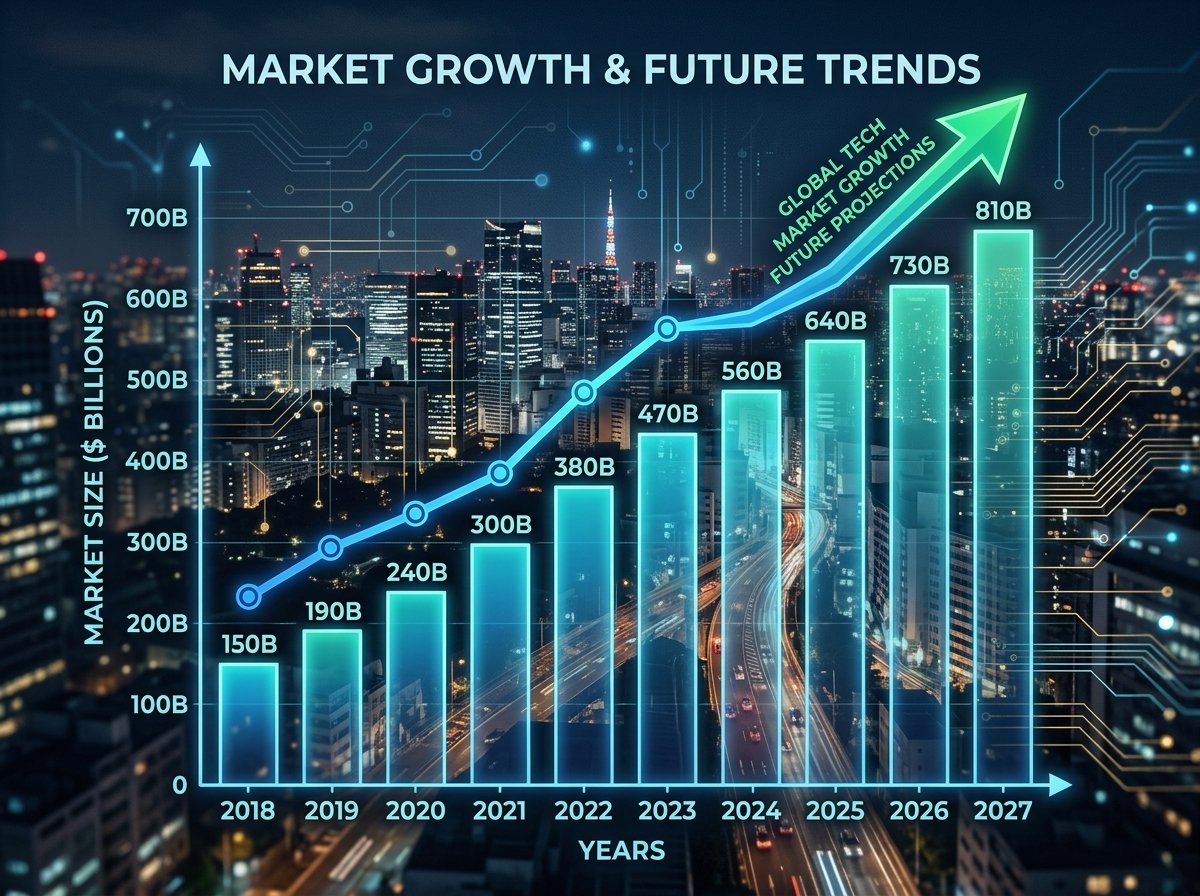
The global emerging technologies market is expected to reach 740 billion US dollars by 2030. It is growing at about 16 percent a year. A market does not grow at that pace on excitement alone. It grows when real buyers sign real contracts, year after year.
One number worth remembering
Sixteen percent a year does not sound dramatic until you do the math. At that rate, spending roughly doubles every four and a half years. A company that skips one budget cycle is not one year behind. It is closer to half a market cycle behind, while its competitors are still learning and making mistakes on someone else’s dime.
That is the real cost of waiting. Not the tools. The learning.
Four things pushing the money
1. Digital transformation never actually finished
Most companies started moving off paper and spreadsheets years ago. Many of them are still doing it. What changed is that the next step now involves automation and AI instead of just moving files to the cloud.
So a project that started as “let us digitise the invoices” has turned into “let us have software read the invoices, flag the odd ones, and route them.” Same budget line. Bigger scope. That budget line keeps getting renewed.
2. Countries want their own tech
Governments have realised that depending on another country for chips, models, and cloud capacity is a risk. So they are funding local chip plants, local data centres, and local AI research.
This is often called tech sovereignty. It matters for one simple reason. Government money does not chase quarterly results. It keeps flowing through slow years, which puts a floor under the whole market.
3. Agentic AI moved from demo to line item
Forrester put agentic AI near the top of its emerging technology list for 2026. Agentic AI means software that does not just answer a question but carries out a task from start to finish.
Companies are funding this because the payoff is easy to describe to a finance team. If a task takes a person two hours and software can do most of it in ten minutes with a human check at the end, the sum works. You do not need to believe in the future of AI to sign that off.
4. Robots stopped being only factory arms
Physical robotics is the other big spender. The old robot was bolted to the floor and did one motion forever. The new one moves around a warehouse, picks things off shelves, and handles objects it has not seen before.
Warehousing, logistics, and manufacturing are the first real buyers here. These are industries with a lot of repetitive physical work and a constant struggle to hire.
Who is actually spending
It is easy to assume this is all big tech buying from big tech. It is not.
The biggest buyers are the boring ones. Banks. Insurance companies. Hospital groups. Shipping and freight firms. Retail chains. These businesses have huge amounts of repetitive work, strict rules, and enough money to run a two year project without panicking.
Smaller companies are buying too, just differently. They are not building anything. They are paying a monthly fee for a tool someone else built. That still counts as market spend, and there are a lot of them.
What “emerging” actually means here
The word is doing a lot of work. Market reports usually group a few things together:
- AI tools and platforms, including the ones businesses already use daily
- Autonomous agents and agentic AI
- Quantum computing and post quantum security
- Advanced robotics, including humanoid and mobile robots
- Neuromorphic computing, which is chip design modelled on how brains work
- Edge computing and new connectivity
Some of these are already in everyday use. Others are still mostly in labs. Lumping them together makes the headline number bigger than it feels on the ground, so read those reports with that in mind.
How to tell hype from real adoption
You do not need an analyst subscription for this. Four questions get you most of the way.
Can someone name a customer? Not a pilot. Not a partnership announcement. A paying customer who uses it in normal operations.
Is there a price? Real products have pricing pages. Hype has “contact sales” and nothing else, for years.
Is anyone hiring for it? Job listings are honest. If ten companies in your industry are hiring people to run a technology, it is real. If nobody is, it is early.
Has it survived a bad quarter? Tools that only get funded when business is good are nice to have. Tools that survive a budget cut are load bearing.
What this means if you run a small business
You are not expected to buy a quantum computer. Nobody is asking you to.
The useful move is smaller. Pick one task your team does every week that everyone quietly hates. Find out if a tool already handles it. Try it for a month. Write down what it saved and what it broke.
Do that four times a year and you will have built something more valuable than any single tool. You will have a team that knows how to judge new technology instead of guessing.
What to watch next
Three things are worth keeping an eye on over the next 18 months.
Agentic commerce, where software buys and reorders things on a business’s behalf, is moving fast and will change how supplier relationships work.
Humanoid robots are getting cheaper faster than most people expected, which brings them within reach of mid sized warehouses rather than only the giants.
Post quantum cryptography is quietly becoming a compliance requirement, not a choice. That one will land on IT teams whether they were watching or not.
Frequently asked questions
How big is the emerging tech market?
It is projected to reach around 740 billion US dollars by 2030, growing at roughly 16 percent per year. That figure covers several technologies grouped together, including AI, robotics, and quantum computing.
Why is emerging technology growing so fast right now?
Four reasons stack on top of each other: ongoing digital transformation projects, government spending on local tech capacity, budget moving into agentic AI, and real demand for robots in warehouses and factories.
Is this a bubble?
Parts of it probably are. Individual companies will fail and some products will be quietly shut down. But the underlying spending is coming from operating budgets and government programmes, not just venture capital, which makes a total collapse less likely than a messy shakeout.
Which emerging technology should a small business look at first?
AI tools for daily work. They are cheap, they need no engineers, and you can cancel them next month. Quantum computing and robotics are not relevant to most small businesses yet.
How long until these technologies are normal?
Some already are. AI writing and automation tools crossed that line a while ago. Agents are close. Quantum computing is still several years from being something a typical business touches directly, though its security side arrives much sooner.