Blog
AI Agents vs AI Chatbots: The Real Differenece

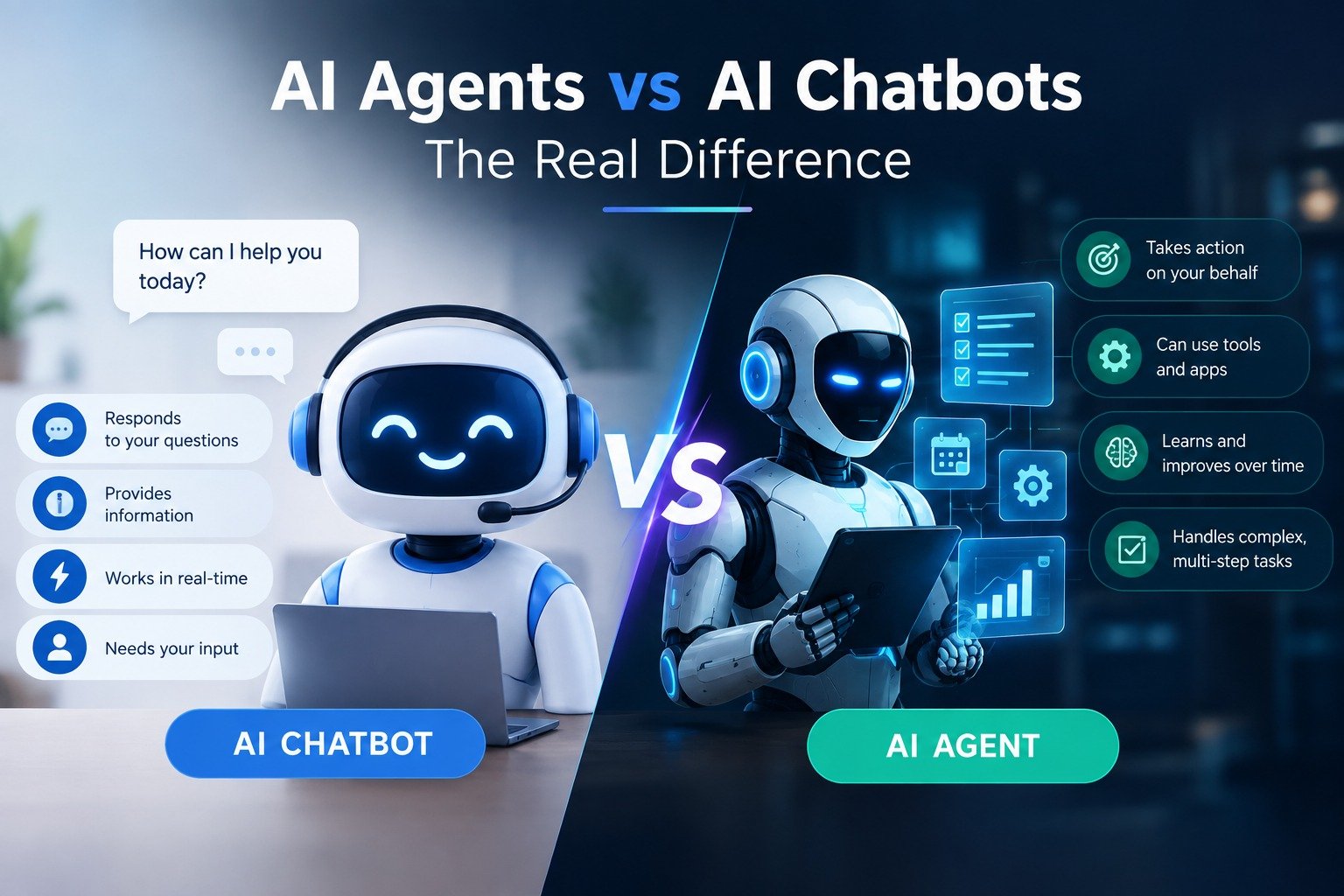
A chatbot answers. An agent acts. You ask a chatbot a question and it gives you a reply. You give an agent a goal and it goes off, takes several steps using real systems, and comes back with the job done.
That is the whole difference. Everything below is detail.
Why people mix them up
Both are built on the same kind of AI model. Both often use a chat box. From the outside they can look identical.
Vendors have made this worse. Plenty of products renamed their chatbot as an agent because agents sell better right now. If you are being sold something, the name on the box tells you nothing.
A worked example
Say you want to book a meeting with three people across two time zones.
Chatbot version. You ask it to help schedule the meeting. It explains how to find overlapping time, maybe suggests good hours given the time zones, and drafts an invite message for you to send. You then open the calendars, check availability, pick a slot, send the invite, and follow up when one person declines.
Agent version. You say you need 45 minutes with those three people this week, morning preferred. It reads the calendars, finds the overlap, books the slot, sends the invites, and when someone declines it finds the next slot and rebooks. You get a message saying it is done.
Same underlying model. Completely different amount of your time spent.
The four things an agent has that a chatbot does not
Tools. A chatbot can only produce words. An agent can call a calendar, query a database, send an email, update a record, or run code.
Multiple steps. A chatbot does one turn and stops. An agent runs a loop, deciding its next move based on how the last one went.
Memory across steps. It keeps track of what it tried, what failed, and what it learned within the task.
A goal instead of an instruction. You describe the outcome, not the method. The agent works out the method.
Take any one of those away and you are back to a chatbot with extra features.
What chatbots are genuinely better at
This is not a case where the newer thing wins everything.
Chatbots are better when you want to stay in control. Writing, brainstorming, analysis, explanation, code review. Anything where your judgement is the point and you want to see each step.
They are cheaper. Fewer calls, less setup, less that can go wrong.
They are easier to trust. A chatbot cannot accidentally email your whole customer list, because it cannot email anyone.
And they are faster for one off questions. Sending an agent off on a loop to answer something you could have asked directly is a waste.
What agents are better at
Anything repetitive with a clear finish line. Ticket triage, data cleanup, monitoring, routine coding fixes, scheduling, running the same multi step process every week.
Anything that spans several systems. The value of an agent is largely that it does the copying and pasting between tools that a human currently does.
Anything that happens while you are not there. An agent can run overnight on a schedule. A chatbot waits for you.
A quick way to decide
Ask one question. Does this task need someone to make judgement calls along the way?
If yes, use a chatbot and stay in the loop.
If no, and the steps are the same every time, an agent is a candidate.
Then ask a second question. What is the worst thing that happens if it gets this wrong? If the answer involves money leaving the company, a customer receiving something odd, or data being deleted, put a human approval step in before the risky action.
Cost and effort, honestly
A chatbot is a subscription. You sign up and start using it the same day.
An agent is a project, even a small one. Someone has to connect the tools, set the limits, decide where the human checkpoints go, and watch it for the first few weeks. Budget for that time, because teams that assume an agent works out of the box are the ones that give up in month two.
Agents also cost more to run. Many steps means many model calls. It is usually still cheaper than the human hours it replaces, but it is not free and the bill can surprise you if a loop misbehaves.
What about AI assistants
A third word gets thrown around and it sits in the middle.
An assistant is usually a chatbot with a few tools attached. It can look something up or check your calendar, but it does not run long loops on its own. Think of it as a chatbot that can fetch things.
Most products marketed as agents today are actually assistants. That is not a scandal. Assistants are useful. Just know what you are buying so your expectations match.
Frequently asked questions
What is the main difference between an AI agent and a chatbot?
A chatbot responds to messages one at a time and produces text. An agent is given a goal and takes multiple steps on its own, using real tools such as calendars, databases, or email, until the task is finished.
Is ChatGPT an agent or a chatbot?
It is mainly a chatbot, though it has agent style features when given tools and longer tasks. The same product can behave as either depending on how it is set up and what it is allowed to access.
Which one does my business need?
A chatbot for work where human judgement matters and you want to see each step. An agent for repetitive multi step tasks with a clear definition of finished. Most businesses end up using both.
Are AI agents more expensive than chatbots?
Yes, usually. They make more model calls and need setup time to connect tools and define limits. The cost is normally still lower than the human hours saved, provided the task was well chosen.
Can an AI agent work without a human checking it?
For low risk tasks, yes. For anything involving money, customer communication, or deleting data, nearly every team keeps an approval step. Match the level of oversight to the cost of a mistake.